

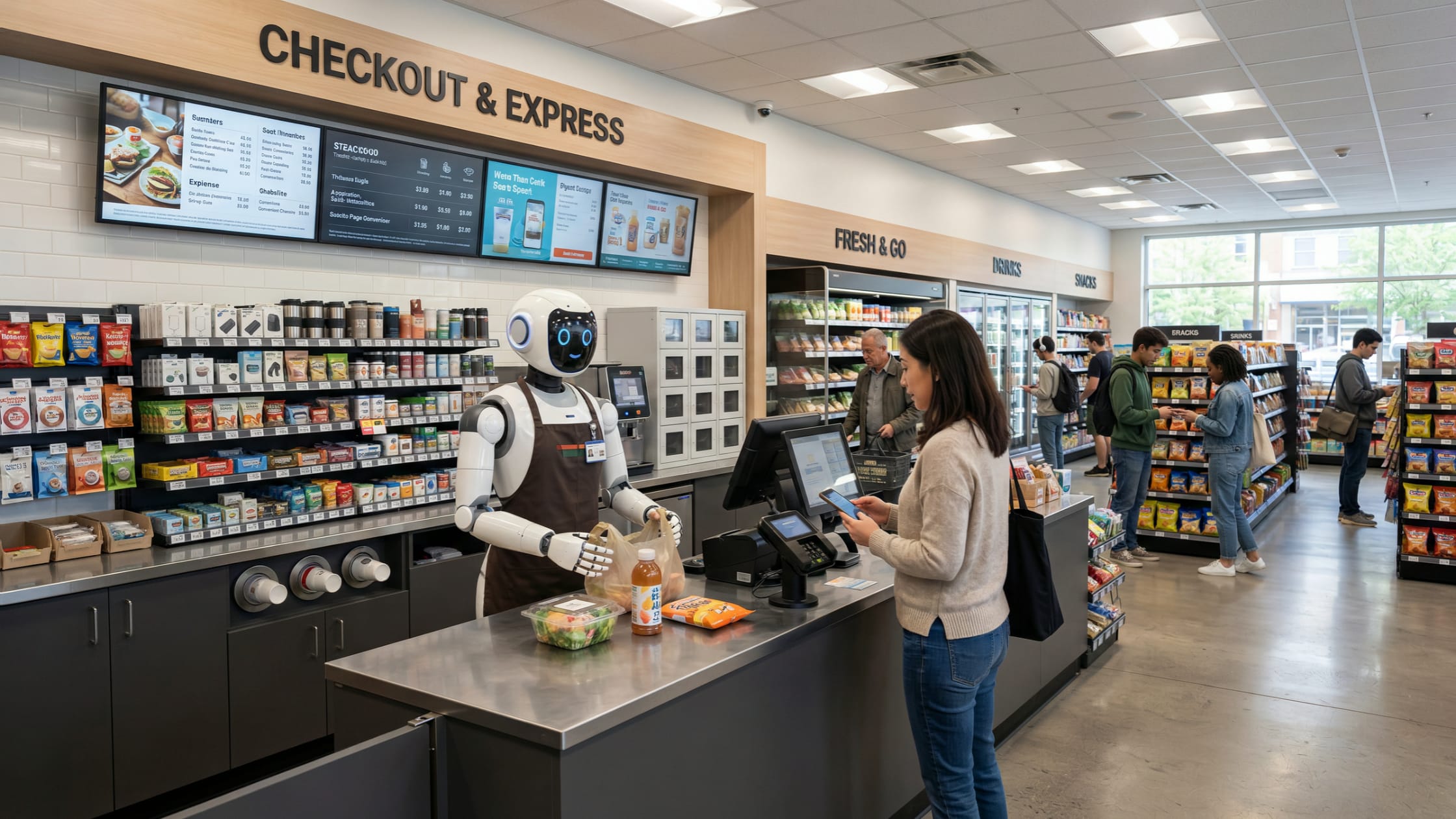
The local convenience store has always been defined by proximity. It is the shop that is open when the supermarket is shut and close enough to reach on foot. By 2030, that proximity will be worth far more than a place to buy milk and a newspaper. A store a few minutes from thousands of homes is also a natural base for rapid delivery, a safe collection point for parcels, and a small, data-rich business that can forecast what its street will buy tomorrow.
That shift is already under way, driven by rising costs, changing shopper habits and the need to protect staff and stock. This article looks at where it leads. It covers quick commerce and delivery margins, autonomous checkout, AI stock forecasting, loss prevention and payment security, and sustainable packaging, and it ends with a practical roadmap for retailers who want to be ready. Where it looks beyond today's evidence, it says so.
What will the convenience store look like in 2030?
By 2030, the typical successful convenience store will be a local services hub: a compact shop whose back room doubles as a fulfilment point, whose entrance hosts parcel and returns services, and whose ordering, security and payments are run largely by software. The shelves will still matter, but the store will earn from far more than what it sells over the counter.
The pressure behind this change is already visible. The UK has around 50,000 convenience stores providing over 456,000 jobs, yet retailer investment fell to about £900m a year in 2025 and 2026 from over £1bn in 2024, according to the Association of Convenience Stores (ACS). With less capital to spend, every square foot has to earn more. Where this article looks ahead, it projects from current evidence and says so.
What to expect by 2030
- Delivery becomes a normal store function. IGD forecasts UK quick commerce will grow 10.7% a year to £5.5bn by 2031, mostly fulfilled from existing stores.
- Margin depends on owning the customer. Marketplace commission will push retailers toward their own apps, flat-fee couriers and larger baskets.
- Checkout fades gradually, not overnight. Expect self-checkout and scan-and-go to be standard, with sensor-based checkout in selected compact formats.
- Forecasting software sets the order. Published pilots show food waste falling by roughly 15% to 37%, and these tools will be built into routine replenishment.
- Security becomes one connected system. Shop theft in convenience stores fell for the first time since 2022 as retailers spent a record £313m on prevention, and that spending will shift toward connected tools.
- Packaging rules reshape choices. Changes to Plastic Packaging Tax in April 2027 and the Deposit Return Scheme from 1 October 2027 will be settled law by 2030.
Where is convenience retail heading from today?
Three pressures are pushing stores toward the 2030 model.
- Cost. The ACS 2026 Local Shop Report says higher employer National Insurance contributions and business rates are holding back investment, so stores need income that does not depend on selling more of the same.
- Shopper behaviour. IGD found quick commerce use rose from 19% of shoppers in November 2024 to 22% in March 2026. People increasingly expect a local shop to be available on their phone.
- Crime. Theft and abuse have forced security spending that would have seemed extreme a decade ago, which is also pushing retailers toward smarter, data-led operations.
Early versions of the 2030 store already exist. Tesco's Whoosh delivers from about 1,800 stores, Co-op's quick commerce offer runs from more than 1,700, and Co-op hosts over 900 parcel lockers. The next four years are about making those experiments standard, profitable and available to smaller operators.
Will convenience stores become fulfilment and services hubs by 2030?
Many will, but in a partial form: a dedicated zone rather than a converted shop. A fulfilment hub in this sense means a small area given to picking, rider handover and parcel collection, with the front of store kept for impulse purchases, fresh food and food-to-go.
The direction is already clear. IGD calls store-based fulfilment the dominant quick commerce model because it uses existing infrastructure and improves route density. Co-op has stated an ambition to double its quick commerce proposition by 2030. On the services side, InPost reports over 14,600 automated parcel machines in the UK and expects convenience store use to keep growing, and Evri is installing 500 lockers at forecourts. Lockers matter because they turn a parcel collection into a store visit, and Co-op has also opened an access-to-cash banking hub inside a store.
By 2030, expect the successful hub store to combine:
- a pick zone near the back door, working from the same live stock count as the shop floor
- a handover shelf for riders, with ambient and chilled totes
- a locker bay for collections and returns, run with one or more carriers
- extended or unattended hours where demand justifies it, following Co-op's trials of 24-hour delivery in London, Leeds and Manchester
- selected community services that bring regular footfall
To prepare the floor plan, map under-used space such as the stockroom or an exterior wall, separate picking routes from shopper routes, start with lockers because they are the lowest-effort service to add, and measure sales per square foot before committing more space.
What will the quick commerce business model look like in 2030?
Expect a more integrated, more owned and more basket-driven model than today's. Quick commerce (q-commerce) means delivering a limited range of everyday items in roughly an hour or less from a nearby store. The pure-play start-ups Getir and Gorillas exited the UK in 2024, and IGD says the model is now defined less by speed than by how well it fits existing store operations.
By 2030, the likely pattern is a mix of routes with the balance shifting toward the retailer's own channel:
- Marketplace listings on Deliveroo, Uber Eats or Just Eat stay useful for reach and new customers, but IGD warns that aggregator partnerships can dilute margin and weaken customer ownership.
- White-label delivery, where a platform supplies riders and technology under the retailer's brand, grows. Co-op was the first UK grocer to use Deliveroo Express this way.
- Own app or website with a flat-fee courier becomes the profit engine for repeat customers. Uber Direct, for example, advertises delivery from a retailer's own site at a flat fee from £3 with no commission.
What will profit margins on delivery retail look like?
Thin, and decided by basket size and channel. Deliveroo is typically quoted at 25% to 35% commission per order, and a reported Nisa deal cut the rate for exclusive partners from 30% to 25%. The comparison below uses assumptions for illustration only: a £20 basket, a 25% gross margin (£5.00 gross profit) and a £1.00 picking cost.
- Marketplace at 25% commission: commission of £5.00 takes all the gross profit, leaving a loss of £1.00 per order.
- Own channel with a £3.00 flat-fee courier: £2.00 remains after the courier, and £1.00 after picking.
- Own channel with a £3.00 courier and a £2.50 customer delivery fee: £3.50 remains after picking.
Larger baskets fix most of the problem. Sacra's modelled US example puts a mature ultrafast dark store at about 13% contribution margin on a basket of roughly £19 at 500 orders a day, while broader online grocery needs closer to a £38 basket to work (both converted from US dollar figures). Passing commission on through higher shelf prices has limits: Which? found Asda groceries cost on average 19% more via Just Eat, 28% via Uber Eats and 31% via Deliveroo, and customers notice. The levers that will matter to 2030 are minimum baskets, delivery fees, loyalty integration, retail media income and moving repeat customers to the retailer's own channel.
How do you start a rapid delivery service on the way to 2030?
- Pick a tight range of fast sellers, essentials and food-to-go, so picking stays quick and stock accuracy stays high.
- Choose one route first. A single marketplace plus your own direct channel is easier to run than five platforms.
- Set basket rules. Minimum orders and delivery fees stop one-item orders destroying margin.
- Design the pick process, deciding who picks, where and when, with one live stock count across shop and delivery.
- Match service hours to demand.
- Review weekly on cost per order, order accuracy, late deliveries and the share of orders that are incremental to in-store sales.
Will checkout disappear by 2030?
Not entirely, and not in most stores. The likely outcome is a spectrum: attended tills for complex or age-restricted sales, self-checkout and scan-and-go as the standard, and sensor-based checkout-free shopping in selected compact formats where footfall is predictable.
The early evidence explains the caution. Aldi closed its checkout-free Greenwich store in 2026 and brought back self-checkouts, and Sainsbury's removed Amazon's Just Walk Out system from its Holborn store, while Tesco still runs GetGo stores. Grabango's checkout-free business failed and Amazon has pulled back, and an analyst quoted by Which? said the price point is too high for wider supermarket adoption.
What could change the picture by 2030 is better AI accuracy and falling costs, which would widen the range of stores where checkout-free pays back. The real prize may not be the missing till. Payments consultant Richard Crone argues autonomous checkout is about capturing first-party, item-level purchase data, which feeds forecasting and loss prevention.
A small retailer should expect to climb in stages:
- Modern self-checkout or scan-and-go through a phone app.
- Unattended or extended-hours formats, where staff cost is the main problem.
- Sensor-based checkout-free, only in a compact format with strong footfall and a vendor willing to share accuracy and shrink data.
At each stage, measure queue time, transactions per labour hour, shrink rate, item recognition accuracy and cost per transaction. If a pilot cannot show gains on at least two of these, do not scale it.
How will predictive analytics run the convenience store of 2030?
By 2030, forecasting software is likely to propose most orders, leaving staff to approve exceptions. Fresh food and food-to-go come first, because short shelf life makes every forecasting error expensive.
The published results point that way, though most come from vendors or pilots and should be treated as indicative:
- A machine-learning forecasting project for fresh food across 168 convenience stores cut product waste by 37% and costs by 22%, according to the vendor's own published case study.
- WWF-backed pilots of AI ordering in two US grocery chains reduced food waste by 14.8% per store on average.
- A May 2026 academic study of three grocery stores found AI forecasting can help cut waste even when conventional accuracy scores do not improve, and recommends measuring waste directly.
How will stores predict localised consumer demand?
Through signals that differ street by street, not a chain-wide average:
- Own sales by hour and day, at product level.
- Weather, which moves drinks, ice cream, hot food and umbrellas.
- Local events and calendars: school terms, match days, festivals, paydays and bank holidays.
- Footfall changes, such as a new office, a closed competitor or road works.
- Delivery orders by postcode, which show demand the shop front never sees.
- Supplier lead times and promotions, so the forecast reflects what can actually be restocked.
Stores should judge these models on waste and availability, not only forecast accuracy.
Which inventory management trends will define 2030?
- Automated replenishment driven by forecasts, rather than manual reorder guesses.
- Waste-aware ordering and markdowns, so near-date stock is discounted before it is binned.
- One stock view across shop and delivery, because selling an item online that is not on the shelf damages trust. AI forecasting is already used to reduce stock-outs in UK quick commerce.
- Electronic shelf labels and shelf or fridge sensing, which keep prices and availability accurate with less labour.
- Supplier data sharing, so promotions and delivery schedules feed the forecast.
The common requirement is clean data. A retailer that fixes product codes, counts stock accurately and records waste will get more from any tool than one that buys software first.
What will loss prevention look like in cashless, low-staff stores by 2030?
Expect layered, connected systems that deter, detect, respond and learn, rather than a single device. Cashless trading removes cash handling and cash robbery risk, but self-checkout misuse, walk-outs and age-restricted sales still need controls.
The trajectory is already set. The ACS 2026 Crime Report counted 5.8 million shop theft incidents in convenience stores, down from 6.2 million, the first fall since 2022. Retailers invested a record £313m in prevention, up from £265m, on CCTV, security tagging, protective screens, facial recognition and AI store monitoring. Crime still costs the sector an estimated £354m, or £7,137 per store. The British Retail Consortium recorded 5.5 million detected theft incidents costing nearly £400m, and violence and abuse down from 2,000 to 1,600 incidents a day. The Crime and Policing Bill is set to create a standalone offence of assaulting a retail worker and remove the £200 threshold for low-level theft.
Which retail security technology trends will matter most?
- Cameras that raise alerts rather than just record, using AI video analytics.
- Item-level protection through weight sensing or tagging on high-theft lines, with exception reports on unusual self-checkout activity.
- Faster response, including body-worn cameras and simple evidence sharing with police. ACS found 64% of operators now report more incidents to police.
- Shrink analytics by product, shift and time of day, so protection moves to the hotspots.
Facial recognition and similar tools bring UK data protection duties, so retailers should take advice before deploying them.
How will digital payment terminals be secured?
As part of the store's security perimeter. PCI DSS 4.0.1 is the only active version of the card industry standard, and all 51 requirements that were previously future-dated became mandatory on 31 March 2025, so by 2030 these controls will be routine. The PCI Security Standards Council publishes a plain-English Small Merchant Guide to Safe Payments. A sound baseline for any shop includes:
- Approved, encrypted terminals supplied through your acquirer, with point-to-point encryption where available.
- A separate network for terminals, away from guest Wi-Fi, CCTV and office devices.
- Daily inspection for tampering, and a register of every terminal by serial number.
- Prompt firmware updates and no default passwords.
- Multi-factor authentication and named accounts for back-office access.
- Confirmation with your acquirer of which self-assessment applies. Shops with standalone, internet-connected terminals typically complete a short questionnaire such as SAQ B-IP, but check your own.
What will sustainable packaging mean for convenience snacks by 2030?
By 2030, three regimes will be settled and packaging choices made in 2026 and 2027 will have locked in much of the cost:
- Plastic Packaging Tax: £228.82 per tonne from 1 April 2026, on plastic packaging with under 30% recycled content. From 1 April 2027, pre-consumer waste will no longer count toward that 30% threshold.
- Extended Producer Responsibility: from 2026 to 2027, fees vary by recyclability rating, with red about 20% above the base fee and green an estimated 9% below. Missing data is penalised like red.
- Deposit Return Scheme: launches 1 October 2027 across the UK, with a flat 20p deposit recommended. Shops should check whether they will need to take back drink containers and plan space for it.
These duties fall mainly on producers, importers and brand owners, so retailers should check which apply, particularly for own-label snacks and food packed in store.
What is the business case for green packaging?
The strongest case is cost avoidance and compliance readiness, not a price premium. Pro Carton's 2026 survey found 71% of UK consumers will keep buying sustainable products only if they cost the same, though they would pay about 6% more on average. BCG's 2026 survey found the share willing to pay a green premium has stayed at around 17%. In crisps, 30% of UK adults say packaging sustainability affects what they buy. Greener packaging therefore needs to pay for itself through lower fees, lower risk and better supplier terms. In practice, that means:
- Audit own-label snacks, bakery and food-to-go containers and carrier bags.
- Ask suppliers for recyclability ratings and recycled-content figures, and prefer those who can supply them.
- Right-size packs and secondary packaging, which cuts material cost and transport volume together.
- Compare total cost, including fees and tax, not only the unit price of the pack.
What might a day in a 2030 convenience store look like?
This is an illustrative scenario, not a forecast. Before opening, software has already set the day's fresh orders from the weather, local events and last week's sales. At the back door, a picker fills delivery orders from the same live stock count the shop floor uses, while a rider collects from a handover shelf. Customers collect parcels from the lockers and pick up a coffee on the way out. Most shoppers pay by phone or card at self-checkout, with a member of staff nearby for age-restricted sales and help. Cameras flag unusual activity to the manager's phone, and the payment terminals were checked at opening. Nothing in this day relies on technology that does not already exist. The change is that each part works together, and is run to targets for margin, waste and availability.
How should a convenience retailer prepare for 2030?
Sequence the changes so each one funds or de-risks the next. This roadmap is my own analysis, built on the evidence above, so adjust it to your store, your region and your cash position.
- 2026 to 2027, foundations (clean data, security and compliance): fix stock records, add lockers, run a payment terminal and security review, and audit packaging ahead of the 1 April 2027 tax change and the 1 October 2027 Deposit Return Scheme. Track stock accuracy, shrink rate and locker visits.
- 2027 to 2028, test (prove the new revenue streams): launch one delivery route with basket minimums, forecast fresh and food-to-go, and pilot scan-and-go or self-checkout. Track margin per delivery order, waste rate and queue time.
- 2028 to 2030, scale (turn proven pilots into the standard model): expand delivery hours, add services that earn footfall, extend forecasting to the whole range, and consider sensor-based checkout in a compact format. Track sales per square foot, labour per transaction and the share of repeat direct orders.
The consistent rule is to run each change as a measured pilot in one or two stores before committing capital. Co-op's stated ambition to double its quick commerce proposition by 2030 shows how large operators are planning. An independent does not need to match their scale, only their discipline.
Final thoughts: the convenience store of 2030
The convenience store of 2030 will still be recognisable as a local shop, but it will work much harder. Its back room will fulfil delivery orders, its entrance will host parcels and returns, software will set most of its fresh orders, and its security, payments and packaging will be managed as one connected operation.
The common thread is that each change turns the shop's biggest asset, its location, into more than one source of income. The evidence so far also shows that none of it pays automatically. Delivery margins depend on basket size and channel, checkout technology has had mixed results, and shoppers will pay only a little extra for greener packaging. The retailers best placed for 2030 will fix their data first, test each idea in a few stores and scale only what the numbers support. Starting that groundwork in 2026 and 2027 leaves time to get it right.
Frequently asked questions
What is a convenience store services hub?
A small local store that earns income beyond shelf sales. Typical services include rapid delivery fulfilment, parcel lockers and returns, cash access and community services, supported by stock and security technology.
How big will UK quick commerce be by 2030?
IGD forecasts the UK quick commerce channel will grow 10.7% a year between 2026 and 2031, reaching £5.5bn and 15% of online grocery by 2031. Other research firms publish lower figures, so treat any single forecast as a range.
Will convenience stores still have tills in 2030?
Most will, though many shoppers will use self-checkout or scan-and-go. Sensor-based checkout-free shopping is likely to appear in selected compact formats rather than replace tills across the sector.
How much commission will delivery apps charge convenience stores?
Today Deliveroo is typically quoted at 25% to 35% per order, and some symbol groups have negotiated lower rates. Uber Direct offers a flat per-delivery fee from £3 for orders placed on a retailer's own site. Check current terms with each provider, since rates may change.
Will AI run stock ordering by 2030?
It is likely to propose most orders for fresh and fast-moving lines, with staff approving exceptions. Published case studies report waste reductions from about 15% to 37%, but many come from vendors and pilots.
How will cashless stores stop theft?
With layers: visible deterrence, AI or sensor-based detection, a clear response process and shrink data by product and shift. Removing cash reduces robbery risk but does not stop self-checkout misuse or walk-outs.
Do small shops need to be PCI DSS compliant?
Any business that takes card payments is expected to meet PCI DSS, and version 4.0.1 is the current standard. Your acquirer will tell you which self-assessment questionnaire applies.
Will sustainable packaging be compulsory?
Not as a blanket rule, but Plastic Packaging Tax, Extended Producer Responsibility fees and the Deposit Return Scheme from 1 October 2027 put costs on packaging choices. Which duties apply depends on your role, such as producer, importer or retailer.